Table of Contents
Dixie County Courts, FL *

Dixie County in Florida, located in the Big Bend, is a small, rural county among Florida's least populous counties. The county is known for commercial agricultural production and wilderness preservation. Dixie County has a reliable court system that manages a wide range of legal matters to ensure that everyone, including the residents, legal researchers, visitors, and businesses, can access legal services and resources.
The various courts that serve Dixie County are an essential part of the State of Florida's judicial system that promote justice and establish public order. Whether an individual needs to look up court records, fight a ticket, initiate an estate, or seek civil recourse, the local court system provides access and assistance. Citizens of Dixie County turn to its courts for issues regarding property ownership, guardianships, low-level criminal matters, injunctions, breach of contract disputes, and enforcement of local ordinances.
Overview of the Dixie County Court System
The Dixie County court system operates under the Florida Courts and is supported by the Office of the State Courts Administrator, which oversees judicial affairs across Florida. Dixie County is part of Florida's Third Judicial Circuit, comprising several neighboring counties: Columbia, Hamilton, Lafayette, Madison, Suwannee, and Taylor. Florida has 20 Circuit Courts throughout the state, but the Third Judicial Circuit is the largest circuit by area. The Third Judicial Circuit has jurisdiction over more substantial cases involving civil, criminal, juvenile, probate, and family law.
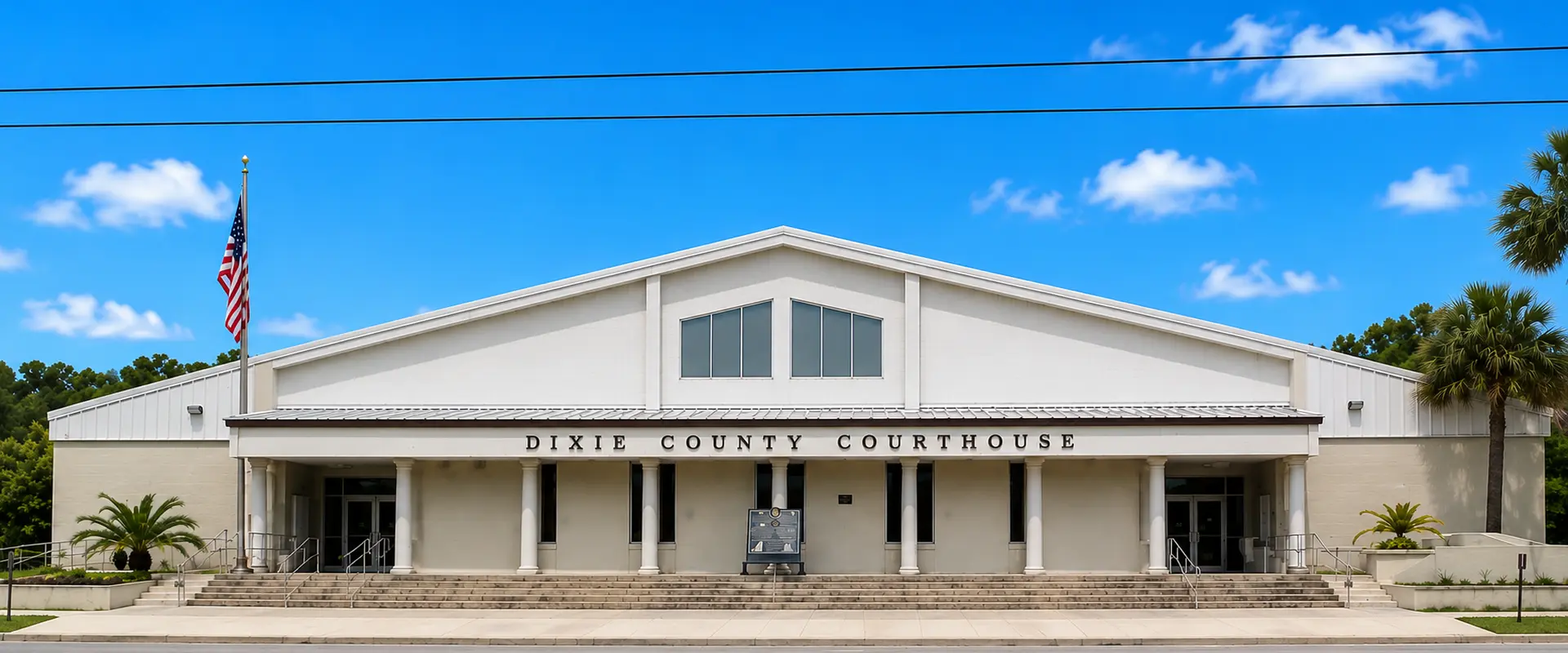
Dixie County's main court operations are located in its county seat, Cross City, where the Dixie County Courthouse contains the court administration, offices, filing divisions, and records storage, along with many court services. Many Dixie County residents working with court cases deal primarily with the Clerk of Court's office for filings, payments, hearing schedules, certified documents, and to obtain public records.
Types of Courts in Dixie County, FL

Choosing the right court to file a case in is an important aspect of the legal process because errors could lead to wasted time, dismissed documents, and even additional costs. Each of the courts has defined duties and jurisdictional responsibilities that determine the type of cases they handle. Understanding the court system saves residents time and money.
 Judicial Circuit Court
Dixie County is served by the Third Judicial Circuit Court of Florida, which is responsible for processing the county's serious legal issues. This court is also found at the Dixie County Courthouse and handles cases including:
- Felonies
- Family Law Matters, including divorce and child support
- Probate matters
- Juvenile delinquency
- Guardianships
- Major civil lawsuits
- Appeals from the County Court
- Mental health proceedings
The circuit court has jurisdiction over many more complicated matters and large-scale cases requiring significant evidentiary procedures and potentially long-term resolutions, including felony charges. Family law issues and probate matters, especially those dealing with large estates, are common throughout the Third Judicial Circuit. Individuals in circuit court often enlist legal representation for this type of proceeding due to the complex nature of the case.
Primary Location: Columbia County Courthouse, Lake City, Florida
 County Court
The County Court in Dixie County processes many of the county's legal matters. This level of court is generally more accessible to citizens for handling smaller criminal offenses and civil matters.
It deals with cases including:
- Misdemeanor criminal offenses
- Traffic violations
- Small claims actions
- Landlord-tenant issues
- County code violations
- Civil infractions
The county court is frequently residents' first experience with the court system, processing a high number of cases for traffic and municipal code violations, and more common local legal issues. Though often less formal than circuit court, county court processes demand the same attention to procedure and deadlines. Individuals with small claims and landlord-tenant matters often represent themselves in this court.
Main location: Dixie County Courthouse
 Specialty Courts
The Specialty Courts in the Third Judicial Circuit serve Dixie County and all of the other counties in the Third Judicial District. Specialty courts are judicial proceedings that address underlying issues like substance abuse and mental health to promote rehabilitative solutions and increase accountability in offenders.
These include:
- Adult Drug Treatment Court Program
- Mental Health Court
- Military Veterans and Service Members Court
Specialty courts address many root causes of recurring illegal activity. Drug Treatment Court programs allow eligible participants to complete treatment and rehabilitation while under the strict supervision and monitoring of the court, whereas Mental Health Courts offer individuals who may have a mental health disorder treatment alternatives rather than incarceration. The focus of Military Veterans and Service Members Court programs is on veterans and active duty service members who may have issues that can be attributed to military service, such as trauma, substance abuse, or mental health issues. Eligibility and the nature of a case will influence inclusion in specialty courts.
Primary Location: Third Judicial District of Florida, in the County Courthouse where the case originated, on a rotating calendar.
How to Access Dixie County Court Records

Most court records in Dixie County are public in Florida. Public access means people like lawyers, the residents, and companies can check filings, case updates, and verify any outcomes. However, some records, like juvenile cases, private legal matters, and family law matters such as adoptions, have restricted access or are sealed to protect privacy.
Online tools can make court searches easier and quicker, but individuals may need to visit the clerk's office in person for certified copies or old records. Some information requests or copying will have associated fees.
 Online Access
Although some state court records have been available in Florida since 2004, Florida began to digitize their records following an order by the Florida Supreme Court in 2014. Online access to public court records is available through the State Courts Administrator under the Florida Courts system and the Dixie County Clerk of Court. Residents can search by people involved, filing dates, or case numbers using the drop-down menu. It's advised to have correct information when searching for a court record online because even slight differences in names, mixed-up spellings, or dates wrong might lead to confusing results.
 Alternative Online Options
Some people might find using online court systems difficult, especially if they aren't familiar with Florida courts or are unsure which court has the records they want. Websites such as CourtCaseFinder combine public records from many areas and might help with finding information about cases from different sources. They may be particularly helpful when trying to find older cases or when trying to figure out where records might be kept. Third-party aggregators are able to locate a case quickly, even when information may be missing or incomplete.
 In-Person Requests
For certified copies, records that are stored in archives, or some protected records, individuals may need to request them in person from the Dixie County Clerk of Court.
Clerk staff can help with finding:
- Paper case files
- Old court records that are kept in archives
- Official copies of documents
- Probate records
Providing as much detail as possible when residents make their requests can speed things up. Having the case number, names of people involved, the year it was filed, or any citation information can help them find the information quickly. The Clerk of Court staff is able to answer questions regarding court procedures, filing, and court records.
 Archived Records
Older court records for Dixie County may be in physical storage or an archive; hence, the best approach is often to begin with using the online systems and then ask the clerk for help. Those who require archived records available in physical files should contact or visit the office of the Dixie Court Clerk of Courts. These records, including historical probate records, older civil matters, and closed criminal cases, may take a bit longer to get out of storage. Older official records dating back to 1920 are available via the County Clerk of Courts website. Also, residents are able to locate archived court information via the Florida State Archives.
For Attorneys and Legal Professionals
Lawyers who work in Dixie County need to follow both the general Florida court system rules and the specific practices of the county court. All lawyers and legal professionals are subject to the rules and regulations of the Florida Bar. Attorneys who are used to bigger city court systems may find things work a little differently, such as how cases are scheduled and what is expected for filings. Therefore, it's best to reach out to the Clerk's Office early about how to access court records, become familiar with standing court orders, schedule hearings, and submit documents.
Legal professionals who want to obtain certified copies, probate filings, or archive records should also plan to contact the Clerk's Office before they need the records. This is because there might be additional processing required or records that need to be manually retrieved for older cases. Keeping their files well-organized and staying on top of deadlines will help them avoid problems in their ongoing legal work.
How to File a Case in Dixie County

When bringing a new court case in Dixie County, residents must adhere to filing procedures and ensure they file their cases with the correct court and understand the filing requirements. Understanding the filing procedure ensures smooth case processing by minimizing delays and preventing case dismissal for filing in the wrong court. The step-by-step procedures for filing a case in Dixie County are outlined below.
Step 1: Choose the Correct Court
First, residents have to determine the court that has jurisdiction over their issue. Typically, the County Court handles misdemeanors, traffic citations, lower-value civil lawsuits, and small claims disputes. The Circuit Court handles felony cases, probate proceedings, family law matters, guardianships, and larger civil cases. This is essential because if they file in the incorrect court, the case can be dismissed, delayed for transferring courts, and cost more to file it at the appropriate court later.
 Step 2: Complete Required Forms
Most of the forms for cases in Dixie County are available through the Dixie County Clerk of Court & Comptroller. Residents of the county can also use the statewide Florida Courts Help platform for standard family law and probate cases, as it provides both forms and instructions. After residents access the forms, they should be completed accurately and in full to ensure a successful case filing. Incomplete forms are a common cause for the dismissal of a filed case. They should pay close attention to all instructions given on the paperwork and include any necessary supporting documents and signatures. If citizens have questions, they can always reach out to the Clerk of Courts office.
 Step 3: File the Case
After completing the correct forms, people can turn them in to the County Clerk's Office in person. Some courts may require the case to be e-filed using the e-filing system on the Florida Courts website, particularly when filing forms for civil lawsuits. In general, however, residents have the option to file online or file in person. When filing the forms, one should ensure they attach the required documents, such as copies of contracts and agreements. The clerk's office will assign the case a number once it has been accepted for filing. This case number is essential as they will use it to monitor the case. Anyone who has problems with filling out forms or filing the case should call or visit the Clerk of Courts Office.
 Step 4: Pay Filing Fees
There are several types of cases that require filing fees, such as all civil cases, family law cases, and probate cases, which require a more substantial payment than others. Some common, but less complex, case types are small claims and traffic citations, which require a minimal fee. If an individual is unable to pay the filing fee, they can submit an Application for Determination of Civil Indigent Status to request a fee waiver to the County Clerk of Court, providing proof of financial hardship. If the resident is filing online, they will pay the fees online by credit or debit card when they e-file. Residents who file in person can pay with cash, cashier's check, or money order.
 Step 5: Serve the Other Party
After a case has been accepted for filing at the appropriate division, the opposing party must be officially notified about the lawsuit. This is done through the process commonly known as service of process. A deputy sheriff or an authorized process server most often performs service because those filing the case are not permitted to serve the respondents themselves. A proof of service will also need to be filed in the appropriate division of the court. It is recommended that residents keep copies of the records for their future reference. A 2023 revision of the law in Florida allows for e-mail or general mail for a service of process under specific guidelines.
 Step 6: Monitor the Case
Once the case is filed, they can monitor its progress using the case number for notices and court dates. This can be done through the Dixie County Online Court Records Search portal or by contacting the office of the County Clerk of Court. For a broader search, they can use the State Courts Administrator platform. Tracking the case helps individuals to follow up on its progress and learn the hearing dates and any updates by the court. This is essential because missing a filing deadline or appearing in court can have severe legal consequences. Residents who may have an issue with tracking their case can always call or visit the Clerk of Courts Office.
Dixie County Courthouse Directory
Dixie County Courthouse
The county's courthouse serves as the primary center for judicial operations, housing the County Court, Third Judicial Circuit Court (main administration is headquartered in Lake City), the County Clerk of Court‘s office, and the specialty courts, including the Adult Drug Treatment Court Program, Mental Health Court, and Military Veterans and Service Members Court. The courthouse handles felony and misdemeanor cases, family law matters, probate administration, traffic disputes, civil litigation, and public records requests.
Cross City
Address: 214 NE 351 Highway, Cross City, FL 32628
Phone: (352) 498-1200
Legal Help and Self-Help Resources
Several organizations, both local and statewide, and nonprofit organizations offer assistance in navigating legal processes in Dixie County. Assistance is not just for people who can't afford lawyers; veterans, senior citizens, researchers, people handling probate cases, and people unfamiliar with a legal process may also need procedural or legal support.
 Free Legal Assistance
There are organizations, like Florida Rural Legal Services, that offer free assistance to moderate to low-income residents with various civil legal problems, such as housing, family law, consumer problems, and public benefits. There is also the Three Rivers Legal Services, which is the main civil legal assistance provider for Dixie County. It offers help with consumer issues, elder law, housing, and family law. The Florida Courts System also offers free self-help resources that provide forms, procedures, family law information, and filing requirements.
 Local Legal Support
In Dixie County, there are local legal clinics, volunteer attorney programs, and Florida Bar referral services that assist the public with various needs. They include the Virgil D. Hawkins Civil Legal Clinic, which provides legal help in family law and juvenile cases. Those seeking the services of volunteer programs can opt for Tri-County Community Resources Inc., which manages community resource centers and volunteer advocacy efforts. Finally, residents can answer questions through Florida Free Legal Answers, sponsored by the American Bar Association. People can ask questions to attorneys who practice in every area of civil law.
FAQs
How can I search for court records in Dixie County?
Individuals can search for court records through the Dixie County Clerk of Court, Florida's Online Court Search Tool, or by visiting the clerk's office at the courthouse to do so in person. Having a case number, a party's name, or the filing date can make the search process much simpler. For some older or certified records, an additional waiting time or fee may apply to retrieve them.
Are probate records in Dixie County publicly accessible?
In most cases, probate records are public records unless a judge has sealed the case due to its nature, such as those involving sensitive information. Records of estate filings, wills submitted for probate, and guardianship proceedings are normally part of the circuit court division's public record. Individuals interested in researching family estate histories or property transfer records can submit a public record request form at the clerk's office.
What is the duration it takes to obtain certified court records?
The period to obtain certified court records in Dixie County varies depending on the age of the record and the location. Therefore, it can take a few business days or up to a week or two to get the records requested. Those whose requests have priority for an attorney to use in court on short notice can discuss expediting the process with the clerk.
When should someone consider using a third-party records search?
A third-party records search service like CourtCaseFinder can simplify the process of locating and reviewing a broad range of public records for an individual who is struggling to find information within official online or local databases. They are also helpful to those who need to find records from several official systems simultaneously.
What types of litigants are eligible for Mental Health Court?
Generally, any defendant may be eligible for Mental Health Court if their criminal conduct is the result of mental health problems. If they are confirmed eligible, the case can be adjusted to accommodate a specialized Mental Health Court plan with required treatment and monitoring by the Third Judicial Circuit Court.
Can an individual be allowed to represent themselves in Dixie County courts?
Under Florida law, individuals have the right to represent themselves, or pro se, in various civil legal proceedings, especially small claims cases and simple traffic infractions. For more complex cases involving felonies, estates that must go through probate, custody disputes, or major financial claims, having legal representation may prove beneficial.
Other Counties in Florida
- Alachua
- Baker
- Bay
- Bradford
- Brevard
- Broward
- Calhoun
- Charlotte
- Citrus
- Clay
- Collier
- Columbia
- De Soto
- Duval
- Escambia
- Flagler
- Franklin
- Gadsden
- Gilchrist
- Glades
- Gulf
- Hamilton
- Hardee
- Hendry
- Hernando
- Highlands
- Hillsborough
- Holmes
- Indian River
- Jackson
- Jefferson
- Lafayette
- Lake
- Lee
- Leon
- Levy
- Liberty
- Madison
- Manatee
- Marion
- Martin
- Miami-Dade
- Monroe
- Nassau
- Okaloosa
- Okeechobee
- Orange
- Osceola
- Palm Beach
- Pasco
- Pinellas
- Polk
- Putnam
- Saint Johns
- Saint Lucie
- Santa Rosa
- Sarasota
- Seminole
- Sumter
- Suwannee
- Taylor
- Union
- Volusia
- Wakulla
- Walton
- Washington
Table of Contents