Table of Contents
Jefferson County Courts, FL *

Jefferson County is located in the northern part of Florida and is named after the 3rd president of the United States, Thomas Jefferson, who died the year before the county was formed in 1827. The county seat is Monticello, the only incorporated city in the county.
Jefferson County has a well-established unified court system that aligns with the Florida Judicial Court system and has presided over civil, criminal, family-related, probate, and juvenile cases, among others. These legal hearings in Jefferson County have been successfully presided over by the county's two trial courts, the Circuit Court and County Court.
Overview of the Jefferson County Court System
Jefferson County falls within Florida's Second Judicial Circuit, which comprises five other counties, namely Franklin, Gadsden, Leon, Liberty, and Wakulla. The Second Judicial Circuit is made up of 16 Judges and 10 County Court judges who preside over a wide range of legal matters.
Jefferson County's court system is administratively supported by the Clerk of Courts' office, which is responsible for records management. The office handles marriage licenses, passports, official records (deeds), recording, and court appeals filings alongside the courts, making it an important part of Jefferson County's court system.
Types of Courts in Jefferson County, Florida

Understanding the different types of courts within the Jefferson County Court system sheds significant light on the cases they preside over, primarily the six key divisions: Circuit Criminal, Circuit Civil, Circuit Family, Circuit Probate, County Criminal, and County Civil. Understanding which court presides over each case is important because each Jefferson County court has its own jurisdictional limits set by statute; filing in the wrong court results in dismissal or transfer.
 Circuit Court
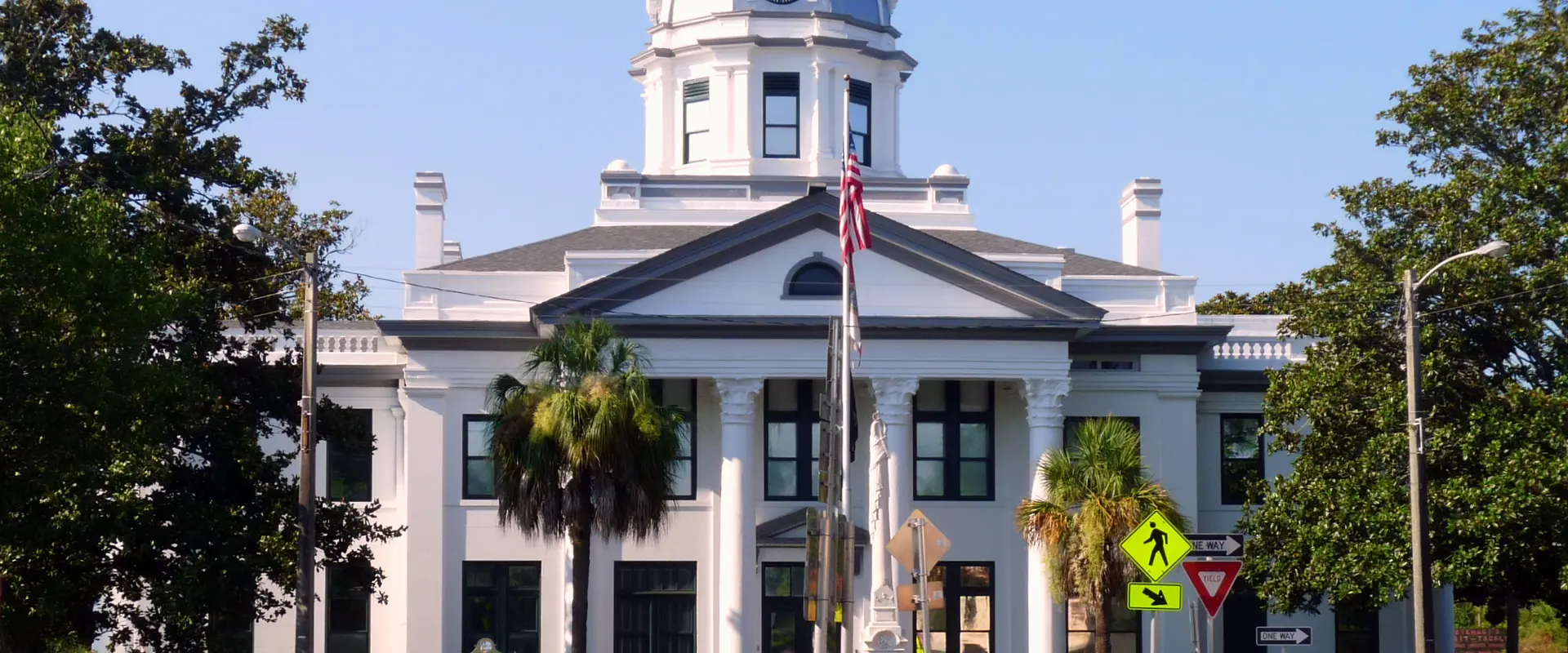
The Second Judicial Circuit Court is the county's higher trial court. The court is located inside the historic Jefferson County Courthouse at 1 Courthouse Circle and presides over the following cases:
- Felony criminal cases
- Civil disputes involving more than $50,000
- Family law matter
- Mental health commitments
- Real property and mortgage foreclosure cases
Circuit Court cases in Jefferson County are heard by Judges from Florida's Second Judicial Circuit, who travel to Monticello, as the county lacks a dedicated resident Circuit Judge due to its small population and caseload.
 County Court
The County Court, the lower of Florida's two trial court levels, is located within the county's historic Jefferson County Courthouse. It presides over the following legal matters:
- Civil disputes involving $50,000 or less
- Small claims cases up to $8,000
- Misdemeanor criminal offenses (e.g., simple battery, DUI, petty theft)
- Criminal and civil traffic violations
A County Court Judge from the Second Judicial Circuit's 10-judge County Court bench is assigned to preside over Jefferson County matters. The County Court, called "the people's court" in Jefferson, because most of its case hearings involve everyday citizen disputes, is the court most Floridians encounter.
How to Access Jefferson County Court Records

Under Florida's public records law, Chapter 119, Florida Statutes, and Article I, Section 24 of the Florida Constitution, most of Jefferson County court records are publicly accessible. Not all court records are public, however, such as sealed or redacted records. These records include juvenile delinquency files, adoption records, sealed criminal records, and certain mental health and family law documents containing confidential information. These private records are sealed under Florida Rule of Judicial Administration 2.420, designed to ensure information privacy in cases that involve minors, victims of sexual offenses, adoptions, mental health, and individuals whose records have been expunged or sealed by court order.
 Online Access
Online access is one of the most widely used ways to obtain Jefferson County court records, since residents do not need to visit the Courthouse in person. Jefferson County has a dedicated online resource for searching its court records, called the Jefferson County Online Court Records Search (OCRS). The platform offers users a user access architecture of public anonymous access, attorney for attorneys of record, registered user with login required, and party access for parties to case-level access. On the portal, residents can access records including case numbers, party names, case status, hearing dates, docket entries, filings, and dispositions for criminal, civil, family, probate, traffic, and juvenile cases.
 Alternative Online Options
In addition to the state- and county-provided online access platforms, Jefferson residents can use alternative platforms to access County Court records, such as CourtCaseFinder. These platforms are useful for users or residents who do not have the specific court record details needed to extract case records from the state-provided portal. OCR's interface is functional but bare-bones; users sometimes find it confusing when they're unsure of the case type, the party's spelling, or the county where the case was filed. But with alternative options, platforms aggregate public records from multiple sources, allowing users to search for court cases, divorces, arrests, and other public filings across jurisdictions in a single interface, making online court record searches much easier.
 In-Person Requests
In addition to the online approach, Jefferson County residents can physically visit the county clerk's offices within the county courthouse to access physical case files, archived paper documents, certified copies of court records, recorded official records (deeds, mortgages, liens), and marriage license records. To easily get help with physical visits, residents are advised to provide identification information, as this helps the Clerk staff search more quickly and accurately when given a case number, full party name, date of filing, or case type.
 Archived Records
It is also possible for residents to access archived records, which are mainly on paper and stored in the Clerk's vaults at the historic courthouse. Most of these records predate digitization; therefore, digital access to them has not been fully integrated. Court clerks can assist with searches, but keep in mind that physical retrieval can take more time than online records.
For Attorneys and Legal Professionals
For an out-of-state attorney, the practical difference they are likely to experience when they visit the Jefferson County court system is the fewer hearing dates held each month compared to most other larger county courts. This means that filing cases requires a clear understanding of the court's hearing dates, as determined by the county's calendar. To learn the Jefferson County local procedures and judicial preferences, one must access the Circuit Court Manual and the standing administrative orders published by the Second Judicial Circuit. They cover local rules, case management procedures, and judge-specific preferences.
When filing cases, an out-of-state attorney needs to understand that e-filing is mandatory within the Jefferson County court system and that the portal covers the filing of all types of cases within the county. And when they need access to county court records, attorneys can use the Jefferson County Online Court Records Search (OCRS). To appear in a Jefferson County case, an out-of-state attorney must move for pro hac vice admission, of which they can only appear three times within 365 days.
How to File a Case in Jefferson County

Filing a case within Jefferson County is one of the most sensitive interactions filers have with the county system. It marks the starting point of most cases and requires the filer's attention to detail and a good understanding of the county Court structure. Errors within the filing process can result in case rejection and dismissal. Some common errors include selecting the wrong court to preside over the case, filing the wrong case form, and paying the wrong filing fees. Filers can successfully file their cases by following a step-by-step process that breaks the procedure into small, verifiable steps to ensure no errors occur during filing.
Step 1: Choose the Correct Court
The first step in the process entails selecting the correct court that presides over the filer's case. Jefferson County has several courts that preside over various cases, starting with the County Circuit Court, which handles the county's major cases, including large civil claims, family law matters, juvenile cases, and mortgage foreclosures. This is then followed by the County Court, which presides over the county's minor cases, such as traffic violations, small claims, and civil claims of less than $50,000.
 Step 2: Complete Required Forms
Having selected the correct court, the filer can now comfortably proceed to the second step: completing the appropriate case forms. In Jefferson County, these can be accessed through the Florida State Court Forms Library portal. From the platform, filers can access a wide range of case forms, including civil cover sheets, small claims, family law, and eviction forms. Filers can also access county-specific forms from the Jefferson County Clerk's Forms Center, which provides residents with downloadable forms for filing, recording, and payments.
 Step 3: File the Case
After the case forms are completed, filers must file the case, which can be done electronically or in person. In Jefferson County, e-filing is the default filing method through the Florida Courts E-filing Portal for attorneys, and self-represented filers can file through the portal by creating a free account and filing the case. Filers can also file physically with the Clerk of Courts' office in the County Courthouse.
 Step 4: Pay Filing Fees
Filers are required to pay a filing fee in Jefferson County, which varies between case types and the presiding court. Filers need to first confirm the case filing fee to ensure the correct fee is paid. To do this, filers need to access the Clerk's website page, which displays the current Jefferson County case filing fees. For filers unable to pay the case filing fee, they must complete an Application for Determination of Civil Indigent Status, and once approved, they receive a filing fee waiver.
 Step 5: Serve the Other Party
Once the case is filed, the filer must notify the defendant by serving process, which is carried out by the Jefferson County Sheriff's Office or a certified private process server appointed by the Second Judicial Circuit. The server must file a Return of Service with the Clerk's Office to prove delivery; without it, the case cannot proceed, and the court may dismiss it.
 Step 6: Monitor the Case
The last step of the process revolves around monitoring the filed case. After filing, the filer is provided with a case number that enables them to monitor docket entries, hearing dates, and case status through the Jefferson County Online Court Records Search (OCRS) portal.
Jefferson County Courthouse Directory
Jefferson County Courthouse
Acts as the county's judicial central point, presiding over the county's major cases, which include felony criminal cases, probate matters, family law, and mental health proceedings, among others, and minor cases such as traffic violations, small claims, and misdemeanors are presided over from this courthouse.
Monticello
Address: 1 Courthouse Circle, Monticello, FL 32344
Clerk of the Circuit Court and Comptroller: (850) 342-0218
Circuit Civil Division: (850) 342-0218 ext. 228
Family Law Division: (850) 342-0218 ext. 225
Fax: (850) 342-0222
Website: jeffersonclerk.com
Legal Help and Self-Help Resources
Jefferson County residents can access a mix of nonprofit legal aid organizations, court self-help resources, statewide hotlines, law school clinics, and the Tallahassee Bar Association's Legal Aid Foundation, which covers the entire Second Judicial Circuit, including Jefferson County.
 Free Legal Assistance
Legal Services of North Florida (LSNF), a private, nonprofit organization, is the primary provider of free legal aid serving Jefferson County. The organization handles only civil matters, including domestic and sexual violence, family law, housing, consumer law, public benefits, tax law, elder law, and case management referrals. Also, there is a Tallahassee-based legal aid foundation that serves Jefferson County. The Legal Aid Foundation of the Tallahassee Bar Association provides free or low-cost legal help to low-income Second Judicial Circuit residents with civil cases.
 Local Legal Support
There are nearby law schools that operate clinics open to Jefferson County residents. Florida State University College of Law in Tallahassee runs several pro bono clinics that accept clients from the Second Judicial Circuit, which includes Jefferson County. Also, residents can get local legal support from the Public Interest Law, a specific FSU law clinic that Jefferson County residents can approach for children's advocacy and family law. Residents have access to the Tallahassee Bar Association's Legal Aid Foundation, which operates a Pro Se Program that helps residents connect with lawyers.
FAQs
In the Jefferson County case filing process, what happens if the filer cannot pay the required filing fee?
The filer can access a fee waiver, but they must apply for civil indigent status by filing an Application for Determination of Civil Indigent Status. If the application is approved after review by the Clerk's office, the fee waiver will be granted. To qualify for the program, one's household income must generally fall at or below the Federal Poverty Guidelines.
Can I get married at the County Courthouse in Jefferson County?
Yes, one can get married at the County courthouse. The Jefferson County Clerk's office is located in the building, and one of its main functions is to issue marriage certificates and perform civil ceremonies. For the marriage to take place, both parties must appear in person at 1 Courthouse Circle, Monticello, with valid photo IDs and their Social Security numbers.
Is there a difference between sealing a court record and expunging a record within Jefferson County Court records?
Sealing a court record means making the record hidden from the public, but the record still exists within the Jefferson County court records. On the other hand, expunging a record is to physically destroy the record, meaning that the record is private because it no longer exists since it's permanently destroyed. For both actions, one needs to file an application through the State Attorney's office for the Second Judicial Circuit before the request is filed at the Clerk of Court.
Is it possible for me to look up a case if I only have the defendant's name in Jefferson County Court case records?
Yes, one is able to look up a case with the defendant's name alone using the Jefferson County OCR portal. The system needs no user login for public access. On the platform, enter the available defendant's name, and the system will pull up court records across criminal, civil, traffic, probate, and family divisions. In most cases, the system will pull records from other cases with a similar name, and so to narrow down the results, provide more information like the year or the date of birth of the defendant. This helps narrow down the case records results generated by the system.
Other than going to the sheriff's office in Jefferson County, where can I look up arrest records in the county?
You can check the sheriff's office online, which posts an inmate booking log that helps you avoid making a physical visit to the office. The book log holds recent arrest records, charges, bond amounts, and the booking photos. For the county-related criminal records, such as the charges filed, court dates, and disposition, one does not need to use the OCRS Portal, but if you want to access all this information within a single portal, aggregator platforms such as CourtCaseFinder help you by pulling records across all the public records and giving you a single comprehensive search result.
Other Counties in Florida
- Alachua
- Baker
- Bay
- Bradford
- Brevard
- Broward
- Calhoun
- Charlotte
- Citrus
- Clay
- Collier
- Columbia
- De Soto
- Dixie
- Duval
- Escambia
- Flagler
- Franklin
- Gadsden
- Gilchrist
- Glades
- Gulf
- Hamilton
- Hardee
- Hendry
- Hernando
- Highlands
- Hillsborough
- Holmes
- Indian River
- Jackson
- Lafayette
- Lake
- Lee
- Leon
- Levy
- Liberty
- Madison
- Manatee
- Marion
- Martin
- Miami-Dade
- Monroe
- Nassau
- Okaloosa
- Okeechobee
- Orange
- Osceola
- Palm Beach
- Pasco
- Pinellas
- Polk
- Putnam
- Saint Johns
- Saint Lucie
- Santa Rosa
- Sarasota
- Seminole
- Sumter
- Suwannee
- Taylor
- Union
- Volusia
- Wakulla
- Walton
- Washington
Table of Contents