Table of Contents
Lake County Courts, FL *

Located in central Florida, Lake County has Tavares as its county seat. The county's name comes from its many lakes scattered across the county, totaling 1,400, making it one of the densest freshwater concentrations in Florida. The county ranks among Florida's fastest-growing counties, with a population of 456,068 in 2025, up from 383,956 in 2020, a factor mainly driven by its proximity to Orlando and affordable homes.
The growing county population has led to expansion of the county's court system, which is under the Florida Fifth Judicial District and shared with four other counties: Citrus, Hernando, Marion, and Sumter. The Lake County Court system has presided over a wide range of cases, including criminal, civil, traffic, probate, and estate cases, with success.
Overview of the Lake County Court System
To preside over the wide range of cases, the Lake County Court system comprises two trial courts: a Circuit Court, which represents the court of general jurisdiction in the county and presides over all the major cases within the county, and a County Court, which is a court of limited jurisdiction and presides over the county's minor local cases. Both Courts' court records and administrative processes are managed by the Lake County Clerk of the Circuit Court and Comptroller.
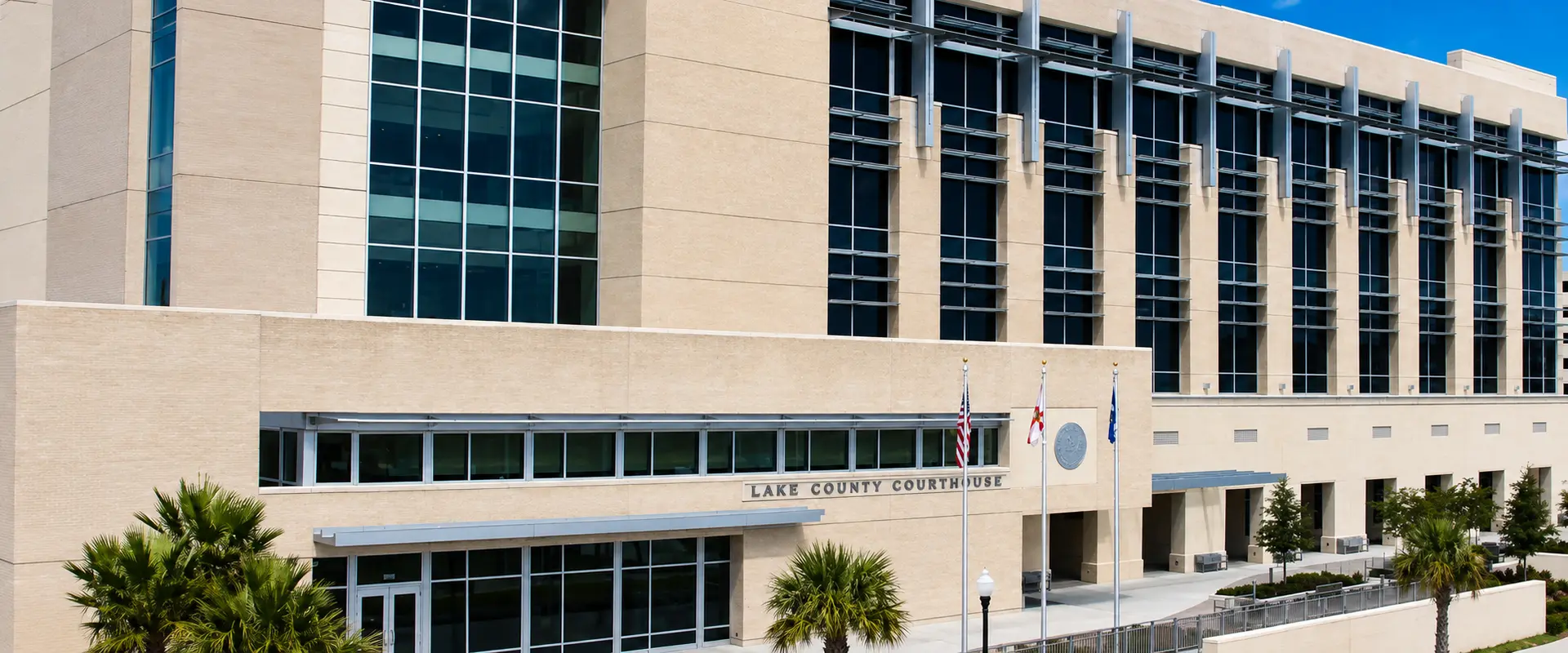
The primary court facility in the county is the Lake County Judicial Center, which houses both the County Circuit Court and the County Court, with courtrooms for both courts in the building. The clerk's office, also located within the courthouse, maintains a second office in Clermont, providing South Lake County residents with a closer access point.
Types of Courts in Lake County, Florida

Understanding the Lake County Court system requires an in-depth understanding of the detailed courts within the county, a deeper look beyond the court system overview, which is important in filing cases and accessing the county court records.
 Circuit Court
The 5th Judicial Circuit Court is the highest trial court in Lake County, handling the most serious criminal cases. The court is located within the Lake County Courthouse, referred to as the Lake County Judicial Center, and from this location, the court presides over the following cases:
- Felony criminal cases
- Civil cases
- Family law and domestic relations
- Probate cases
- Guardianship and mental health cases
- Juvenile delinquency legal cases
- Appeals from the County Court
- Real property and mortgage foreclosure
The Court operates as part of the 5th Judicial District, but within Lake County, it serves as the county's general-jurisdiction trial court. The court's administrative duties, including managing court case records, administering indigency applications, and recording official documents, are carried out by the Clerks of Circuit Court and the Comptroller.
 County Court
The County Court is the second court below the Circuit Court in Lake County and has limited jurisdiction over minor cases within the county. The Court is also located within the Lake County Courthouse, where it presides over the following cases:
- County and municipal ordinance
- Small claims
- Landlord-tenant disputes and evictions
- Recovery of personal property
- Civil traffic infractions
- Misdemeanor criminal cases
- Criminal traffic citations
The court's administrative roles, such as accepting and filing records, maintaining the office's case files, and issuing summons, are managed by the shared office of the Clerk of the Circuit Court and Comptroller.
How to Access Lake County Court Records

Most Lake County Court records are publicly accessible, though a few are restricted, expunged, or sealed. Records such as juvenile delinquencies and dependency, adoption records, sealed or expunged criminal records, and mental health records are not publicly accessible. These records are private for a number of reasons; for example, mental health records ensure the involved parties' health information is kept from the public eye and help prevent stigmatization.
 Online Access
Lake County residents can access County Court records through the Clerk-run Court Case records portal, the ShowCase Platform, which allows them to search by case number, party name, or case type. Where residents can access case records, such as criminal, family, traffic, probate, and other court records, in the county. To easily trace a case on the online platform, one needs the case's identification information. For example, the case number helps the system specifically locate the correct court case records, whereas case party names can pull up multiple cases with similar names. Hence, more case identification materials increase the platform's ease of use.
 Alternative Online Options
As seen on the online court-provided platform, searching for a case record can be challenging, especially if one does not have all the necessary case identification information, such as the case type. This can make the search process time-consuming within county-provided portals. Alternative online commercial options, such as CourtCaseFinder, pull records from multiple public court records, giving users a single comprehensive search result despite the available case identification information. These platforms complement the county-provided platforms by providing a much easier-to-use functionality that helps Lake County residents save time when accessing court case records.
 In-Person Requests
Lake County residents can also access County court records by visiting the County Clerk's offices in the County Courthouse, where most County court case records are held. Residents can request physical case files, archived court records, and certified copies in person. And at the clerk's office, officials can guide residents to the correct division and search methods, helping them save time with older, hard-copy case records. Residents need to provide case record identification information, such as the case number, full names of the involved parties, or the approximate dates the case was filed.
 Archived Records
Lake County residents can access the county's archived court case records, which are mainly in hard copy and predating the year 2003 for most cases. These records are maintained by the clerk's office, which holds a Record Storage Facility for the archived documents. Residents interested in accessing these records must submit a request through the clerk's records storage and court records division.
For Attorneys and Legal Professionals
For an attorney to appear in Lake County courts, they are required to be part of the Florida Bar Association. And for the out-of-state attorneys who want to appear within the Lake County court system, they are required to get the court's permission by first filing a Verified Motion to Appear pro Hac Vice under the Florida Rule of General Practice and the Judicial Administration board; this is to be confirmed by the court where the case is pending. This motion needs to be signed by a local attorney. The process has a set fee of $250 for the pro hac vice motion and an annual renewal fee; the rules also limit repeat appearances to three in 365 days.
Once the pro hac vice motion is approved, out-of-state attorneys need to file cases, and one of the main rules in this process is that within Lake County, e-filing is mandatory and carried out through the state-provided Florida Courts E-filing Portal, which then redirects the filed case documents to the correct clerk's office, such as the Lake County Clerk's office. To access the county court records, attorneys need to use the county-provided ShowCase Search platform, where they can obtain enhanced records by applying for an expanded view.
How to File a Case in Lake County

Filing a case in Lake County is a sensitive process that requires the presence of an informed person. One needs a good understanding of the county court system, the different types of courts within it, and the types of cases they preside over. With only two courts, Lake County's case-filing process is usually straightforward, but it is important to note that filing a case in the wrong court can result in rejection or dismissal, leading to refiling and wasted time. The six-step approach below increases the likelihood of filing a successful case in the Lake County Court system.
Step 1: Choose the Correct Court
One of the key steps toward a successful case-filing process for any filer is identifying the correct court with jurisdiction over the filer's case. Different courts within Lake County preside over different cases, and with two courts to choose from, the filer needs to understand which cases are presided over. The county Circuit Court, which is the court of general jurisdiction in the county, presides over all the major cases within the county, such as felony and criminal cases, family law, probate, and civil claims, among other larger cases. The County Court presides over the local county minor cases as a court of limited jurisdiction. It presides over cases such as small claims, traffic violations, and landlord-tenant disputes.
 Step 2: Complete Required Forms
Each case has its own forms that require different information from the filer. In Lake County, filers can access court forms on the Lake County Clerk's Forms page, where downloadable civil, small claims, probate, traffic, and criminal case forms are available. Filers also have access to standardized state forms via the Florida Court E-Filing Portal. Filers can access the case forms by physically visiting the court clerk's office, where they are provided with the forms and a procedural guide on how to file them.
 Step 3: File the Case
Once the case forms are completed, the next step is to file the case. In the Lake County court system, filing can be done electronically or in person, primarily by self-represented filers at the Clerk's office inside the Lake County Courthouse. Electronic filing is a mandatory requirement for any case filed within the county by an attorney using the Florida Courts E-Filing portal. Filers can also file their cases via mail.
 Step 4: Pay Filing Fees
During the case-filing process, the filer must pay a case-filing fee that varies depending on the case and the court presiding over it. Within Lake County, the Clerk's office maintains a case filing fee schedule accessible on the county website. Filers need to confirm the filing fees to avoid paying the wrong ones, which can result in cases being bounced or rejected. Lake County, like most other Florida counties, has a fee waiver application process that requires the filer to complete an Application for Determination of Civil Indigency, which, once approved, allows the filer to access the case filing fee waiver.
 Step 5: Serve the Other Party
After the case is filed, the defendant must be notified of the case against them, which is done through a process called service of process. Within Lake County, the filer is not allowed to serve the defendant. The process is carried out by the sheriff's office within the county, and once completed, the sheriff records a proof of service with the clerks of court. The proof of service is very important, and without it, the court case hearings cannot proceed.
 Step 6: Monitor the Case
The filer must keep track of the case status within the county court system. The monitoring of the case within Lake County can be done through the ShowCase Search platform, where they can subscribe to the E-Notify account that constantly updates the filer on any changes to the court case through automatic alerts on case activities.
Lake County Courthouse Directory
Lake County Judicial Center
Houses the Circuit Court and the County Court, where all the county legal hearings happen, such as felony criminal cases, civil cases, landlord-tenant disputes, evictions, small claims, and civil traffic infractions.
Tavares
Address: 550 W. Main Street, Tavares, FL 32778
Mailing Address: PO Box 7800, Tavares, FL 32778-7800
Phone: (352) 742-4100
Website: lakecountyclerkfl.gov
Legal Help and Self-Help Resources
Lake County residents can access legal aid from various bodies across the county, including nonprofit organizations and state- and county-provided services such as the clerk's office. These resources help residents navigate the county court system smoothly.
 Free Legal Assistance
One of the biggest sources of free civil legal aid for Lake County residents is Community Legal Services of Mid-Florida (CLSMF), an organization that targets low- and moderate-income residents. The organization provides county residents with access to legal aid for a wide range of civil matters, including housing, consumer and debt, domestic violence, family law, public benefits, elder issues, wills, and probate. The organization does not handle criminal or traffic cases; it focuses solely on civil cases. Residents also have access to other platforms, such as Florida Free Legal Answers, a statewide virtual clinic that offers Lake County residents legal help with civil cases where residents post any civil legal question and then attorneys respond to those questions by email, giving residents access to attorneys with whom they can work based on private arrangements.
 Local Legal Support
To access local legal support, residents can use the Lake County Self-Help Center, a court office located within the Lake County courthouse that helps self-represented parties primarily with family and domestic-related cases. The office ensures residents' case forms are completed correctly to move cases toward final disposition and offers telephonic appointments. Residents can also access the Lake County Library System, which provides legal references important to self-represented residents, accessible at any member library within the county.
FAQs
What happens if I am unable to select the correct court to preside over my case?
If this happens, do not select a court yet, because selecting the wrong court could result in the case being rejected or dismissed. So to avoid this, call or visit the County clerk's office, which is accessible from the County Courthouse. The clerk officials will give guidance on which court has jurisdiction.
Which Lake County court handles a traffic ticket?
Civil traffic infractions and criminal traffic citations are handled by the Lake County Court, with cases processed through the Clerk's traffic division at the courthouse in Tavares. One can usually pay, contest, or elect traffic school online without appearing in person. If the citation involves a more serious charge, it may be heard alongside other criminal traffic matters in the same court.
How do I get a certified copy of a Lake County court document?
Certified copies are issued by the Lake County Clerk of the Circuit Court & Comptroller. Request them in person or by mail at the courthouse in Tavares, and a per-page fee plus a certification charge applies. For older or archived files, the Clerk may need extra time to retrieve the physical record, so it helps to bring the case number and party names.
Can I look up a Lake County case without going to the courthouse?
Yes. The Lake County Clerk offers a free online court records search built on the ShowCase platform, where cases can be looked up by party name, case number, or case type. For added convenience, third-party services like CourtCaseFinder also pull public records from multiple sources into one place, which can help when unsure which office holds the needed record.
Where do I file an eviction in Lake County?
Landlord-tenant evictions are filed in the Lake County Court through the Clerk's county civil division. Submit the complaint and required forms, pay the filing fee, and arrange service on the tenant through the Sheriff. Because eviction timelines move quickly once a tenant is served, keeping copies of the lease, notices, and proof of service helps the case proceed without avoidable delays.
What should I do if I can't afford Lake County court filing fees?
Ask the court to waive or defer the fees by filing an Application for Determination of Civil Indigency with the Clerk. The application reviews income, household size, and benefits against a statewide formula. If one qualifies, they can proceed without paying up front, which keeps the courts accessible regardless of the financial situation. Approval isn't automatic, so provide accurate, complete financial details.
Other Counties in Florida
- Alachua
- Baker
- Bay
- Bradford
- Brevard
- Broward
- Calhoun
- Charlotte
- Citrus
- Clay
- Collier
- Columbia
- De Soto
- Dixie
- Duval
- Escambia
- Flagler
- Franklin
- Gadsden
- Gilchrist
- Glades
- Gulf
- Hamilton
- Hardee
- Hendry
- Hernando
- Highlands
- Hillsborough
- Holmes
- Indian River
- Jackson
- Jefferson
- Lafayette
- Lee
- Leon
- Levy
- Liberty
- Madison
- Manatee
- Marion
- Martin
- Miami-Dade
- Monroe
- Nassau
- Okaloosa
- Okeechobee
- Orange
- Osceola
- Palm Beach
- Pasco
- Pinellas
- Polk
- Putnam
- Saint Johns
- Saint Lucie
- Santa Rosa
- Sarasota
- Seminole
- Sumter
- Suwannee
- Taylor
- Union
- Volusia
- Wakulla
- Walton
- Washington
Table of Contents