Table of Contents
Marion County Courts, FL *

Marion County is situated in the central interior region of North Central Florida, with Ocala as its county seat. With a population of almost 400,000 people, this fast-growing midsize county, known as a home to many retirees, has horse ranches, springs, and many other attractions that make it one of the fastest-developing counties in Florida. The county's court system demonstrates high stability and provides numerous court records across all types of courtrooms, including civil, criminal, family, probate, and municipal courts.
According to the Public Records Act in Florida, most of the records maintained at the Marion County courts are accessible to the public. These court records are routinely searched by people in need of information related to background checks, estates, cases in progress, and title searches. The court system caters to a variety of disputes, from the simplest to the most complicated.
Overview of the Marion County Court System
The courts of Marion County fall under the jurisdiction of the Florida State Courts System, which the Florida Supreme Court and the Office of the State Courts Administrator regulate. The state's trial courts are divided into two hierarchical levels: circuit courts and county courts. Both types of trial courts follow the same statewide procedural rules and are administered at the same state level.
The 5th Judicial Circuit is the circuit that covers Marion County and four other counties within the state of Florida, namely Citrus, Hernando, Lake, and Sumter counties. The circuit administration includes all five counties, but the administration of Marion County itself centers around the courthouse located in Ocala, Florida. The Marion County Clerk of Courts is responsible for overseeing all management activities, including filing requests and processing certified records for all courts in Marion County.
Types of Courts in Marion County, Florida

First of all, when searching for any court records in Marion County, individuals need to understand what kind of court created that particular record. Being made up of the two tiers, Florida's trial courts give jurisdiction based on the type of case as well as monetary value.
 Circuit Court
The 5th Judicial Circuit Court in Florida is the highest trial court that has general jurisdiction. It handles the most significant criminal and civil cases within its purview.
Jurisdiction of the Circuit Court covers the following categories:
- Cases related to felonies
- Litigation involving sums over $50,000
- Family law cases such as divorces, child custody, child support, and adoptions
- Probate, wills, trusts, and estate management proceedings
- Delinquent juvenile cases and dependency matters
- Appeals against the rulings made in the County Court
Substantive court records are maintained in the Circuit Court, including felony case files, civil judgments, divorce decrees, child custody arrangements, and probate inventory lists. In addition to the above-mentioned, the 5th Judicial Circuit also runs special programs, including Drug Court, Veterans Court, and Mental Health Court, each with its own court proceedings and documents. The Marion County Clerk of Courts manages all Circuit Court records in Marion County and can be accessed electronically or in print.
 County Court
The Marion County Court is the lower level for civil and criminal cases within the 5th Judicial Circuit administrative system. It is the most likely court that the majority of Marion County residents would encounter, and it generates a large volume of court records in the traffic, small claims, and misdemeanor categories.
In Marion County, the jurisdiction of County Courts encompasses:
- Misdemeanor criminal cases
- Civil cases with a value of up to $50,000
- Small cases up to $8000
- Traffic offenses and violations
- Landlord-tenant and eviction cases
Some of the most requested county system records are County Court records. These records are frequently accessed online by landlords investigating potential tenants, employers performing background checks, and people investigating their own cases via the Clerk's online portal. Since most County Court proceedings, especially traffic cases and small claims, are settled without an attorney, self-represented parties usually find such records easy to access.
 Probate and Guardianship Division
In Marion County, probate is transacted in a special division of the 5th Judicial Circuit. This department takes charge of proceedings related to death, incapacities, and the management of estates.
This division handles:
- Management of the estates of deceased persons
- Will validation and will contests
- Custodianship of minors and minors who are incapacitated
- Trust administration disputes
- Mental health commitment procedures
Records of the probate court are regularly accessed by the families of the deceased settling the estate, title companies examining the history of ownership of property, and genealogical researchers seeking the family history. The vast majority of proceedings are uncontested and lead to simple public filings. Still, any contested estate and guardianship cases may produce significant court records for a few months or more. All probate records are kept by the Marion County Clerk of Courts, and may be searched by the name of the decedent or case number.
How to Access Marion County Court Records

The Florida Public Records Act, enshrined in Chapter 119 of the Florida Statutes, permits most court records to be accessible to the general public. Confidential court records, such as juvenile cases, family court records involving minor children, and closed criminal cases, are accessible only with a court order or proof of legal standing. All other court records can be accessed through the following methods:
The Florida Public Records Act, enshrined in Chapter 119 of the Florida Statutes, permits most court records to be accessible to the general public. Confidential court records, such as juvenile cases, family court records involving minor children, and closed criminal cases, are accessible only with a court order or proof of legal standing. All other court records can be accessed through the following methods:
 Online Access
The primary source of civil, criminal, traffic, and probate court case files from the county courts is the Marion County Clerk of Courts online records portal. It allows users to search for records by party name, case number, and case category. When searching records across multiple counties in Florida, searches on the Florida Courts E-Filing Portal are more widely available due to their state-level coverage in Circuit and County Courts. Searches will produce accurate results if the researcher has the person's legal name, the approximate filing date, or the case number to begin with.
 Alternative Online Options
State-based websites contain all information but may not be easy to use, especially when a researcher is unsure about where the necessary records could be found. In this case, it may be a particular court or county. CourtCaseFinder is a commercial platform that collects all public records from different locations and courts and makes them available online for anyone interested in accessing court records, such as divorce proceedings, arrests, and filings. This option may be particularly helpful during the early stages of searching in different counties.
 In-Person Requests
Individuals can obtain certified court records, older records that are not digitized, and records that require physical verification from the Marion County Clerk of Courts. The staff will help the researcher access court records according to names or case numbers, and support requests for certified copies. It is always important to provide all possible identifying information, such as the names of the parties involved, the nature of the case, and the year of filing, in order to facilitate access. Note that clerks are not able to give legal advice to researchers.
 Archived Records
The older court records might only be in hard copy form, which means that they could not have been stored with the current records. Researchers who are seeking records from previous decades should contact the Clerk of Courts to locate specific records and make appointments in advance. The Florida State Archives is another resource for older documents. A search online, followed by one made through the Clerk's office, will yield the most effective results.
For Attorneys and Legal Professionals
Lawyers from Marion County file their civil matters on the Florida Courts E-Filing Portal, which is mandatory for most civil matters that arise in circuit and county courts in the state of Florida. However, before filing their matter, lawyers from out-of-county who have cases pertaining to Marion County need to look at the 5th Judicial Circuit's administrative orders on the issues of motion practice, scheduling, and service. In addition, the Circuit Court also has guidelines on the judge and divisional information on the proceedings within Marion County on its site.
How to File a Case in Marion County

To bring a case before the court in Marion County, it is important to choose the right court, fill out the right forms, and ensure that every step of the procedure is taken into account. Inaccuracies in jurisdiction, choice of form, or payment of fees may lead to a delay or the need to resubmit.
Step 1: Choose the Correct Court
The court level depends on the type of cases and the amount of money. The County Court deals with small claims of less than $8,000, misdemeanors, and traffic cases. Civil cases that are more than $50,000, felony, divorce, and probate cases are taken to the Circuit Court.
 Step 2: Complete Required Forms
After choosing the right court, the next step is to fill in the initial petitions and complaints, as well as the summons forms. To make access to the law easier for everyone, legal documents can be obtained from courthouse self-help centers and filed with assistance from the centers' staff and the court clerk's office. Court employees will be able to assist in picking up the correct packet of forms, filing the case, providing informational pamphlets about the procedure, and verifying whether all blanks are filled out when submitting divorce papers, changing a name, dealing with small claims, or protection orders. Alternatively, the Marion County Clerk's website offers free, fillable court forms in Florida, which are ready for submission.
 Step 3: File the Case
In-state attorneys licensed by the state and self-represented parties are required to use the Florida Courts E-Filing Portal to file cases, maintain dockets, and receive real-time judicial notices. If individuals are filing pro se and would rather not use e-filing, they can go to the clerk's window to deliver their paperwork in person. A deputy clerk will be responsible for checking the documents for correct formatting, collecting payments, completing the necessary appearance papers, and affixing case numbers or docket numbers. One may also submit their initiating documents, copies, and a self-addressed, stamped envelope by certified mail to the Clerk's office mailing address. In this instance, the filing will be officially made only when it is received, opened, and processed at the courthouse.
 Step 4: Pay Filing Fees
The cost to file depends on the level of the court and the type of case. Small claims filings commence at approximately $100, and Circuit Court civil filings may be more than $400. The fees are payable upon filing. Individuals who cannot afford the necessary fees could seek a waiver by filing a Statement of Inability to Afford Payment of Court Costs.
 Step 5: Serve the Other Party
Before the case can proceed, the opposing party has to be served with a legal process known as service of process. A licensed process server or the Marion County Sheriff can perform the service. Evidence of service done should be sent to the Clerk of Courts, as the court cannot set up hearings, enter defaults, or do anything until evidence of proper service is on file.
 Step 6: Monitor the Case
The assigned case number can be used on the Marion County Clerk of Courts online portal to track the status of a case once it has been filed, and also to track upcoming hearings and orders that have been filed. To prevent not meeting deadlines or uncontested decisions, it is crucial to be up-to-date with docket entries and court notices.
Marion County Courthouse Directory
Marion County Courthouse
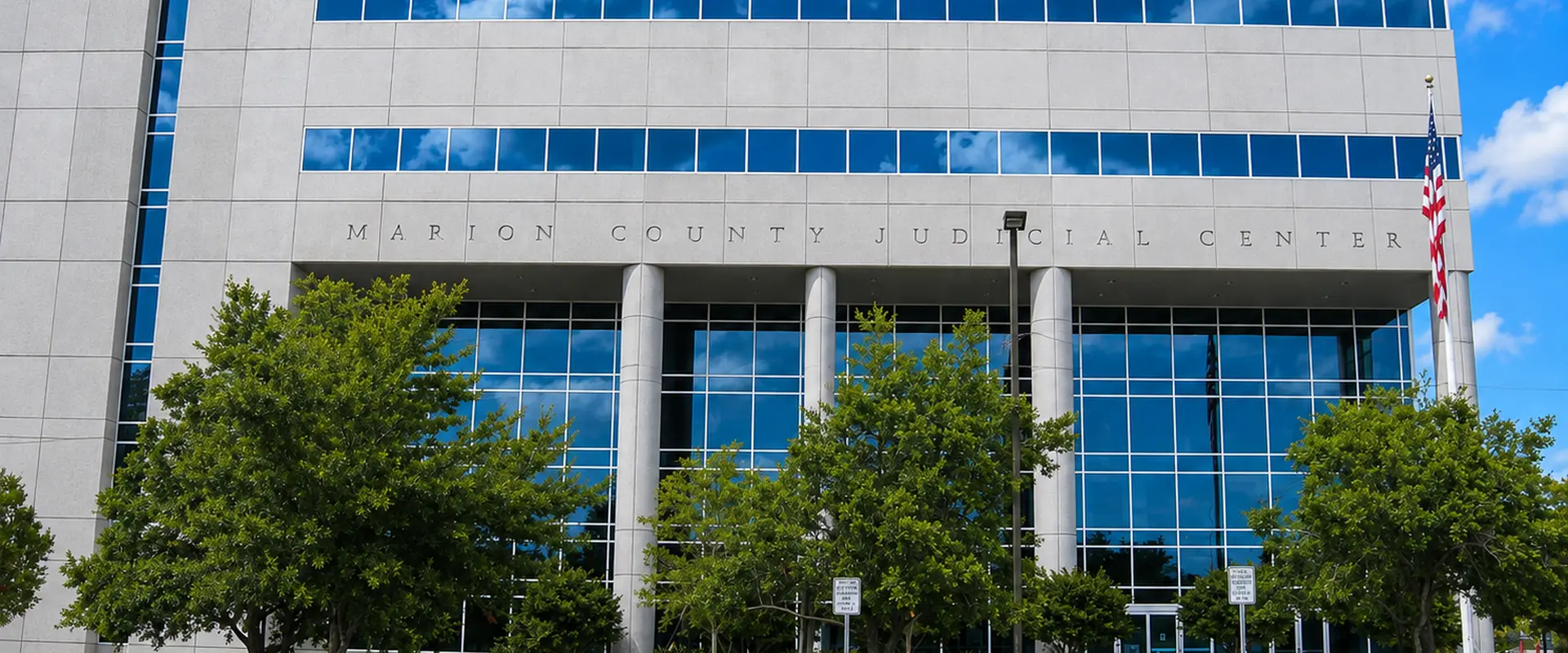
The main venue for all Circuit and County Court activities in the county. It also has the Clerk of Courts office, which is responsible for managing court records, filings, and certified record requests for civil, criminal, family, probate, and traffic cases countywide.
Ocala
Address: 110 NW 1st Ave, Ocala, FL 34475
Phone: (352) 671-5604
Website: 5th Judicial Circuit Court — Marion County
Website: Marion County Court
Website: Marion County Clerk of Courts
Legal Help and Self-Help Resources
Residents of Marion County who have to go through the court system can turn to various state and non-profit organizations that are able to guide them through the procedures, offer legal forms, and even offer direct legal services. Be it the need to find court records or to find representation regarding an ongoing case, the resources listed below apply to a wide variety of cases.
 Free Legal Assistance
Three Rivers Legal Services is a non-profit organization that offers free civil legal representation to people who live in North Central Florida (Marion County) and have low incomes. They provide services in housing, family law, consumer issues, and public benefits, and have online applications accessible on their site. Litigants not within the income eligibility limits can use the Florida Bar's Lawyer Referral Service to get in touch with a licensed Florida attorney to receive an initial consultation at a reduced cost. The staff of the Marion County Clerk of Courts can help in finding the right forms and the steps needed to follow, but may not give any legal advice or guidance on the strategy to use in a case.
 Local Legal Support
The 5th Judicial Circuit's Self-Help Center offers information to self-represented litigants throughout the circuit, including those in Marion County. The broad collection of court forms and step-by-step instructional manuals provided by the Florida Courts Self-Help Center makes self-representation a practical option in this context, in cases of simple matters like uncontested small claims lawsuits or even simple name changes. In situations where there are disputed custody, criminal charges, or large amounts of money, it is highly recommended that a licensed attorney be consulted.
FAQs
How does one search for court records in Marion County?
The Marion County Clerk of Courts online portal is the main search tool used to find civil, criminal, traffic, and probate court records. The searches may be conducted by the name of the party, case number, or case type. In the case of records that are across more than one Florida county, the Florida Courts E-Filing Portal provides a wider statewide coverage. A complete legal name and approximate year of filing are the two factors that will greatly enhance the accuracy of results when starting a search.
Are Marion County court records public?
Most of the records in the Marion County court are open to the public in accordance with the Chapter 119 public records law of Florida. There are exceptions to juvenile records, closed criminal records, and certain family court records involving minor children. When one record fails to be found in a search online, it might be limited, stored in hard copy only, or indexed under a different name. The Marion County Clerk of Courts can explain the status of any record that is not available on the online portal.
Where to find eviction records in Marion County?
The cases of eviction, or, to be more precise, the cases of forcible detainer, are submitted to the County Court, where the Marion County Clerk of Courts keeps the eviction cases. Such court records can be searched in line with the Clerk's online portal by typing either the names of either party or the property address. The eviction records are not confidential and are regularly viewed by landlords, potential tenants, and housing researchers examining rental history.
What is the procedure to get certified court records in Marion County?
The certified court records are available either at the Marion County Clerk of Courts in Ocala or through the mail. Certified copies have a per-page cost and can be paid for in different ways. Before an officer submits a request, researchers are advised to call the Clerk's office directly to find out the current fees, payment methods that are accepted, and the time that the process is expected to take. Providing the case number and the full names of the parties will make the process faster.
What is the Marion County small claims limit?
Florida has a small claims limit of $8,000. Any cases less than that are filed in County Court, as the procedure is designed particularly to become accessible to self-represented litigants. The Florida Courts Self-Help Center offers free forms and step-by-step instructions on how to file a small case in court.
Other Counties in Florida
- Alachua
- Baker
- Bay
- Bradford
- Brevard
- Broward
- Calhoun
- Charlotte
- Citrus
- Clay
- Collier
- Columbia
- De Soto
- Dixie
- Duval
- Escambia
- Flagler
- Franklin
- Gadsden
- Gilchrist
- Glades
- Gulf
- Hamilton
- Hardee
- Hendry
- Hernando
- Highlands
- Hillsborough
- Holmes
- Indian River
- Jackson
- Jefferson
- Lafayette
- Lake
- Lee
- Leon
- Levy
- Liberty
- Madison
- Manatee
- Martin
- Miami-Dade
- Monroe
- Nassau
- Okaloosa
- Okeechobee
- Orange
- Osceola
- Palm Beach
- Pasco
- Pinellas
- Polk
- Putnam
- Saint Johns
- Saint Lucie
- Santa Rosa
- Sarasota
- Seminole
- Sumter
- Suwannee
- Taylor
- Union
- Volusia
- Wakulla
- Walton
- Washington
Table of Contents