Table of Contents
Okeechobee County Courts, FL *

Comprising vast farmlands, cattle ranches, and greenhouses, Okeechobee County is a rural county famed for its rich agricultural traditions. It is also home to the famous Lake Okeechobee, which is the largest freshwater lake in Florida.
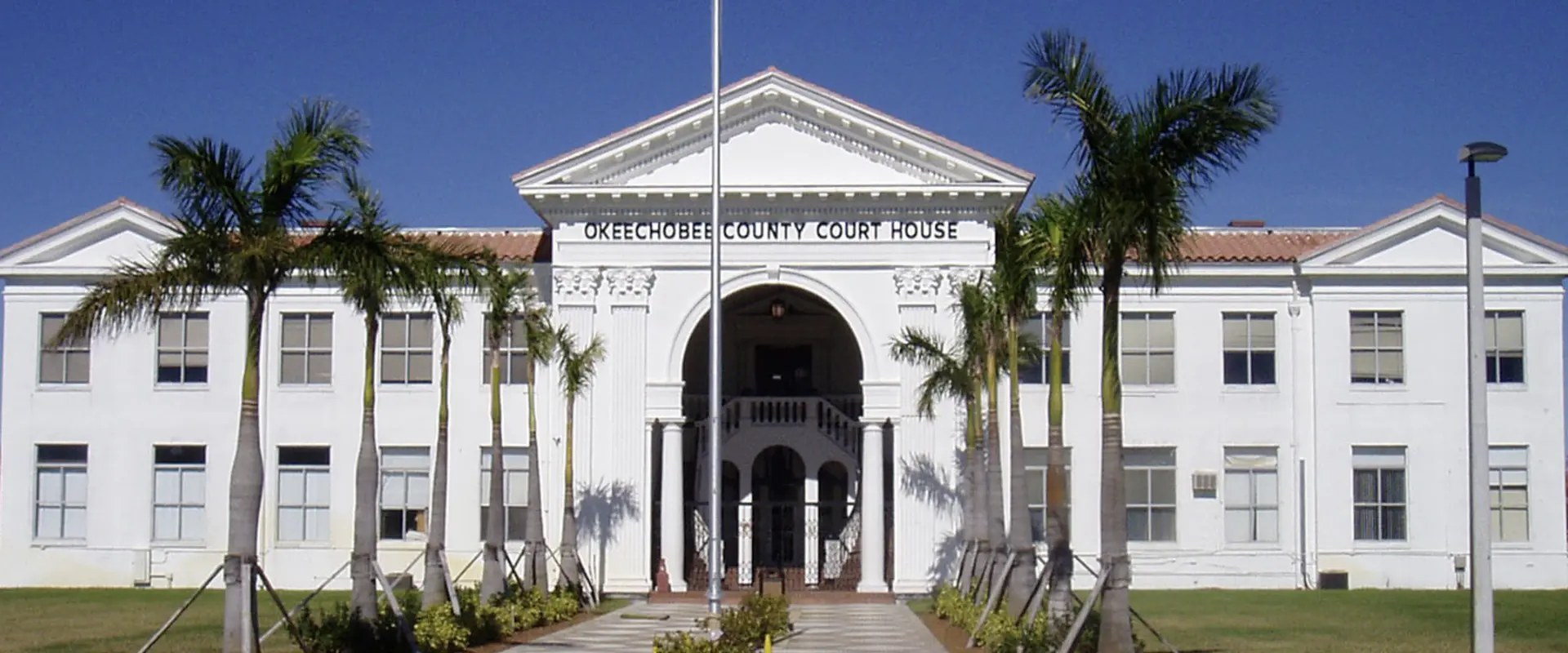
In the heart of downtown Okeechobee sits the new Okeechobee County Judicial Center. The building replaced the historic Okeechobee Courthouse as the center of all legal operations in the county. Here, residents can access court records, file cases, and seek legal redress.
Okeechobee County is part of Florida's Nineteenth Judicial Circuit, which also serves Indian River, Saint Lucie, and Martin Counties. The county has two trial courts that handle a broad range of cases, from civil cases and probate matters to traffic violations and small claims. Residents can visit the courts for other legal services, such as records retrieval, bankruptcy filing, and docket research.
Overview of the Okeechobee County Court System
Okeechobee County courts operate under a two-tier structure as part of Florida's unified court system. Like in all 67 Florida counties, Okeechobee County has a statutory County Court and a regional Circuit Court. Both courts share the main courthouse in Okeechobee City, where all legal proceedings take place.
Also known as the "People's Court", the County Court operates at the local level and handles the highest volume of cases, involving misdemeanor crimes, traffic offenses, and small civil claims. The Circuit Court has two resident judges and handles most jury trials involving serious crimes, such as felony charges, high-monetary civil disputes, and probate matters.
Types of Courts in Okeechobee County, Florida

Okeechobee County has two trial courts, including the County Court and the Circuit Court. Understanding each court's jurisdiction can help residents know where to go to retrieve court records, file cases, and seek legal redress.
 Circuit Court
The Okeechobee County Circuit Court is the county's highest trial court. It is part of Florida's Nineteenth Judicial Circuit and manages most jury trials in the county.
Primary Location: Okeechobee County Judicial Center
Typical cases handled here include:
- Criminal felony cases
- Juvenile delinquency and dependency
- Family law matters
- Civil disputes over $50,000
- Probate matters
- Some appeals from the County Court
The Circuit Court in Okeechobee has two resident judges who preside over serious criminal cases and civil matters. Most trials here are by jury, where a sworn group of individuals hears evidence and reaches a verdict. Given that the court handles high-stakes trials, litigants should consider hiring an attorney for legal guidance and representation.
 County Court
Located at the Okeechobee County Judicial Center, the Okeechobee County Court hears minor legal disputes affecting local communities.
Jurisdiction includes:
- Civil disputes not exceeding $50,000
- Small claims cases not exceeding $8,000
- Traffic offenses
- Misdemeanor crimes
- City ordinance violations
Each of Florida's 67 counties has a County Court, and Okeechobee County is no exception. This trial court operates at the lowest level, handling cases that are mostly punishable by fine, community service, or a short jail term. A single judge presides over all legal proceedings instead of a jury. Sometimes, the Circuit Court may assign cases to the County Court as needed.
How to Access Okeechobee County Court Records

Under the Okeechobee County Court system, the Clerk of Circuit Court & Comptroller is the custodian of all court records. They preserve all case files, dockets, pleadings, and even sentencing records and produce them when needed. While most court records are available to the public, a judge may seal or restrict specific records for privacy or security reasons. Records involving minor identities, victim protection, trade secrets, and mental health remain inaccessible unless obtained by court order.
Okeechobee County residents can access non-confidential court records using different methods:
 Online Access
Most Okeechobee County court records are available online. Anyone interested in accessing these records can do so through the Online Court Records Search portal. The Clerk of the Circuit Court maintains an online database of all court records, allowing anyone to search criminal, civil, probate, or even traffic records by case number, party name, or filing date. Registered users can also view docket entries and scanned case files through the portal.
 Alternative Online Options
Accessing court records through state online portals can be overwhelming, as these portals often handle numerous requests simultaneously. Third-party platforms like CourtCaseFinder can help overcome this issue. This site compiles non-confidential court records from multiple jurisdictions across the state for swift and easy access. One can filter results by name, case number, filing date, or even location. As with statewide record portals, this platform does not maintain sealed or restricted court records.
 In-Person Requests
Not all court records are readily available in the statewide online portal. Okeechobee County courts may sometimes delay in updating their online records. If one cannot find the records they need, they may visit the Clerk of the Circuit Court's office in person during official hours to access them.
An in-person request is ideal for obtaining certified copies and physical records. Requesters should provide details such as the case number, party name, and filing date to streamline the search process. While accessing court records is free, copying and certification fees may apply.
 Archived Records
Anyone interested in historical or archived court records can find them through the State Library and Archives of Florida. The department preserves archival records, including convict records, minute books, and older case files, for reference, research, and educational purposes. While in-person access is free, charges may apply for extensive research, copying, and certification.
Combining online searches, in-person requests, third-party lookups, and archival sources delivers accurate and timely results. These methods ensure that the parties involved obtain the records they need for their legal matters.
For Attorneys and Legal Professionals
Attorneys from outside the county may want to access court records to research legal precedents, verify filings, and check case statuses. Most will discover that access to Okeechobee County court records is through the Online Court Records Search portal. Legal professionals may also consult the Clerk of Court in person for certified copies and archived records.
Whether searching online or in person, all legal professionals seeking court records in Okeechobee County should provide relevant details, such as the case number, court type, and party name, to obtain accurate results. This step can help prevent frustrating delays and streamline the search process.
How to File a Case in Okeechobee County

Filing a case involves strict procedural steps that require keen attention to detail. Before submitting their documents, one must identify the court and the nature of the dispute. Errors and incomplete paperwork are among the reasons for rejected filings. Below are the steps on how to file a case in Okeechobee County:
Step 1: Choose the Correct Court
To avoid delays or dismissals, one should know which court handles what legal matters before filing a case. Okeechobee has two trial courts, each with its own jurisdiction. The Circuit Court handles felony cases, family law matters, civil disputes, juvenile cases, and probate matters, while the County Court hears minor misdemeanor cases, small claims, and traffic violations.
 Step 2: Complete the Required Forms
Filing a case involves completing a number of forms and submitting supporting documents and signatures. The Okeechobee County Clerk of the Circuit Court provides standardized forms for different cases. Filers need to select and complete the required forms per instructions for the clerk to approve their filings. They can always consult the clerk for procedural guidelines, such as the use of various forms and the number of copies required per filing.
 Step 3: File the Case
Okeechobee County courts require attorneys to file cases via the Florida Courts E-Filing portal. Self-represented litigants can file their case in person by submitting their documents directly to the Clerk's Office. For electronic submissions, filers must register an account, select a user role, court type, and case, and then upload their documents. All submitted documents must be in text-searchable PDF format and comply with accessibility and confidentiality rules.
 Step 4: Pay Filing Fees
For any case to proceed, the filer must pay filing fees and the associated court costs. Filing fees vary by case, court, and county. Generally, Circuit Court filings incur higher costs than County Court filings. Individuals who cannot afford filing fees may apply for a waiver by completing the Application for Civil Indigent Status form. Payments are by credit card through the E-Filing portal for electronic submissions or by certified check or money order for in-person filings.
 Step 5: Serve the Other Party
Any time one files a case with the court, they must also serve the other party to notify them of the lawsuit and allow them time to respond. Service of process is usually by a neutral party, such as the local sheriff or a state-certified process server. The server must complete and sign an affidavit to confirm that the other party received the papers. They must then file the completed affidavit with the court as proof of service.
 Step 6: Monitor the Case
Okeechobee County courts handle hundreds of case filings yearly. As a result, some court schedules may change. The court may push hearing dates or set new submission deadlines. Attorneys and litigants should monitor their cases to prevent missed hearings or default judgments. They can track case information via the Online Court Records Search portal or by contacting the Clerk of Court directly for status updates. The courts also have a notification system that alerts registered users about upcoming court events via text or email. Parties involved should provide the case numbers, names, and other relevant details to obtain more accurate results.
Okeechobee County Courthouse Directory
Most legal operations in Okeechobee County take place at the Okeechobee County Judicial Center. The building houses the regional Circuit Court, the Statutory County Court, and the Clerk of the Circuit Court offices. Whether filing a case, retrieving court records, or attending hearings, knowing the exact courtroom locations can help ensure a smooth process.
Okeechobee County Judicial Center
The main courthouse in Okeechobee County houses both Circuit and County Courts, where criminal, civil, probate, family law, and property cases take place. This multi-story building is also where the Clerk of Court operates from, helping individuals access court records and file cases.
Okeechobee
Address: 312 N.W. 3rd St., Okeechobee, FL 34972
Phone: (863) 763-2131
Website: Okeechobee County Judicial Center
Legal Help and Self-Help Resources
Various organizations and law firms in Okeechobee County offer free resources to seniors, low-income families, and vulnerable communities to assist with legal matters. Self-represented individuals can use these resources for procedural guidance and direct legal help when needed.
 Free Legal Assistance
Nonprofit firms like Florida Rural Legal Services Inc. provide free legal assistance to seniors and low-income families in Okeechobee County. Their practice areas include family law, housing, elder law, and consumer disputes. The organization also runs a pro bono program for interested attorneys to provide free legal assistance to eligible applicants. Self-represented litigants can also turn to the Clerk of Court for legal help. While the clerk does not give legal advice, they offer legal forms and answer procedural questions that may help with filing, record searches, and other legal matters.
 Local Legal Support
Okeechobee residents can receive local legal support by attending legal clinics hosted by local firms. Organizations like the Florida Free Legal Answers regularly host virtual clinics where eligible individuals can post non-criminal legal questions for free and receive answers from licensed attorneys. Legal topics covered include family law, housing, juvenile law, and civil rights, among others. Okeechobee County courts also offer several self-help resources to assist litigants in managing their legal problems.
FAQs
Where can one find eviction records in Okeechobee County?
Eviction records are part of public court records, and one can access them through the Online Court Records Search portal. For time-sensitive matters, applicants should visit the clerk's office at the Okeechobee County Judicial Center in person. The clerk can help locate these records, provided that one submits the necessary details, such as the case number and the names of the parties involved. Alternatively, requesters can mail a written request to the clerk and include a self-addressed, stamped envelope to receive their results.
What are the benefits of filing a case electronically in Okeechobee County?
Filers can submit their case documents electronically via the Florida Courts E-Filing portal. This convenient platform lets users upload forms and documents from anywhere without going to the courthouse. Attorneys and litigants can also file cases in batches, saving time and resources. Since the service is free, filers can save on mailing, shipping, or courier costs.
How long does it take to get records in Okeechobee County?
The time it takes to get court records in Okeechobee County depends on the method used. Online lookups are the quickest as they deliver instant results. Requesters can conveniently search for records by name, case number, or filing date, and receive their results online without visiting the courthouse. In-person and mail requests might take a few hours, depending on the extent of the research required.
Are online court record searches always accurate?
The accuracy of online court record searches depends on the submitted details. It also depends on whether the Clerk of Court has updated their online database with the most recent records. Requesters should provide the case number, the citation number, the company or business name, and the party name to retrieve more accurate results.
Are third-party record finders helpful?
Third-party record finders are highly helpful for retrieving quick results. They aggregate data from courts across jurisdictions, making them ideal for conducting in-depth searches. These platforms also have more search options. Users can search by name, phone number, email address, and even location. Some platforms offer value-added features such as case alerts, historical access, and comprehensive reporting.
What information does one need to access court records?
Quick access to court records depends on the information one provides during a search. For accurate results, one should provide the case number, the party name, the company or business name, and the filing date, if available. Providing these details can help the staff locate the requested records swiftly. Third-party platforms like CourtCaseFinder allow users to search and narrow down results by location, email address, and even phone number.
How long do Okeechobee County courts keep records?
Okeechobee County courts keep records in accordance with established retention schedules. The duration court records remain in the database depends on the record type and case. The courts retain felony criminal records and probate records permanently, while civil, small claims, and traffic violation records have a minimum retention period of 5 years. Family law records have a minimum retention period of 10 years, but the court can retain them permanently if they involve minors.
Other Counties in Florida
- Alachua
- Baker
- Bay
- Bradford
- Brevard
- Broward
- Calhoun
- Charlotte
- Citrus
- Clay
- Collier
- Columbia
- De Soto
- Dixie
- Duval
- Escambia
- Flagler
- Franklin
- Gadsden
- Gilchrist
- Glades
- Gulf
- Hamilton
- Hardee
- Hendry
- Hernando
- Highlands
- Hillsborough
- Holmes
- Indian River
- Jackson
- Jefferson
- Lafayette
- Lake
- Lee
- Leon
- Levy
- Liberty
- Madison
- Manatee
- Marion
- Martin
- Miami-Dade
- Monroe
- Nassau
- Okaloosa
- Orange
- Osceola
- Palm Beach
- Pasco
- Pinellas
- Polk
- Putnam
- Saint Johns
- Saint Lucie
- Santa Rosa
- Sarasota
- Seminole
- Sumter
- Suwannee
- Taylor
- Union
- Volusia
- Wakulla
- Walton
- Washington
Table of Contents