Table of Contents
Wakulla County Courts, FL *

Home of the world's largest and deepest freshwater springs, Wakulla County was established in 1843 and has Crawfordville as its county seat, with an approximate population of 34,000 as of 2025. Crawfordville is one of the few unincorporated county seats in Florida. This means that the county government runs county affairs directly. The county falls under Florida's Second Judicial Circuit, which is shared by five other counties. Wakulla County is also among the only three counties in Florida that operate a historic 1893 wooden, timber-frame courthouse.
The Wakulla County Court system is well-developed. It can handle a wide range of cases, from high-profile felony cases, which are handled by the county's Circuit Court, to local small claims cases, which the Wakulla County Court handles.
Overview of the Wakulla County Court System
The Wakulla County court system, which entails the two pre-mentioned Courts, the Circuit Court and the County Court, operates within Florida's State court system, which is made up of a four-tier judicial structure, namely the Supreme Court at the top of the levels, then followed by the District Courts of appeal, and finally the two courts present within Wakulla County.
Operating in the second Florida Judicial Circuit, the County Circuit is served by 16 judges and 10 County Court Judges, led by a chief judge. Within the county, Wakulla has one assigned County Judge, based at the county courthouse, and the Circuit Judges are assigned to cases from the Second Judicial Circuit's 16-judge pool, with no dedicated judge.
Types of Courts in Wakulla County, Florida

To clearly understand the Wakulla County court system, a County Court system provides a clear analysis of the different courts present in the county and their jurisdictional roles.
 Circuit Court
The 2nd Judicial Circuit Court is the higher-level trial court with general jurisdiction in Wakulla County. The court is located within Wakulla County's courthouse and has jurisdiction over the following legal matters:
- Felony criminal cases
- Civil disputes with amounts in controversy exceeding $50,000
- Family law matters
- Probate, estate administration, wills, and trust disputes
- Guardianship proceedings for minors and incapacitated adults
- Juvenile delinquency and juvenile dependency cases
- Mental health commitments
- Appeals from County Court rulings within Wakulla
- Injunctions for protection against domestic, repeat, dating, and sexual violence
- Real property disputes involving title, foreclosure, and eminent domain
The Circuit Court manages its legal proceedings by dividing the court affairs into specialized divisions such as the Circuit Criminal Division, Family Division, and Probate Division, among other divisions. These specialized divisions within the Court help organize the courts' heavy case loads as they are presided over by the judges allocated to the different cases.
 County Court
Wakulla County court represents the local trial court within the county that operates with limited jurisdiction. The court is located within Wakulla County's Courthouse and has jurisdiction over the following cases:
- Misdemeanor criminal offenses (punishable by up to one year in jail)
- Criminal traffic violations, such as DUI and driving with a suspended license
- Civil claims with disputed amounts up to $50,000
- Small claims cases (disputes of $8,000 or less)
- Landlord-tenant and residential eviction matters
- County and municipal ordinance violations
- Non-criminal traffic infractions and citations
The County Court has a strong relationship with the County's Clerk's office, which serves as the court's administrative backbone, responsible for multiple activities within the county, including accepting new filings, issuing case numbers, maintaining court records, and managing jury summons, among other roles.
How to Access Wakulla County Court Records

Accessing court records in Wakulla County is easy, as most of the county's records are publicly accessible. Some of these publicly accessible records include criminal, traffic, family, and probate court records. Then come the sealed and the redacted records, which include juvenile delinquency, juvenile dependency, adoption files, and Baker Act and Marchman Act mental health commitments. These files are kept private, especially in cases revolving around minors, to prevent lifelong reputational harm.
 Online Access
To access publicly available records in Wakulla County, residents can use the Wakulla County Online Court Records Search (OCRS), which is the main portal used by many. The portal gives residents access to a wide range of public court records, including small claims case dockets by name, case number, or citation number.
 Alternative Online Options
In addition to the County-provided online portal, residents can access court records across multiple counties through platforms such as CourtcaseFinder. With the County portals limited to County Court records, one may be interested in court records that span multiple counties; hence, the integration of alternative portals. These portals become powerful tools because they can pull together public record data from multiple Florida counties and present it through a single search interface, which can be useful when a person isn't sure whether a case was filed in Wakulla or in a neighboring county like Leon or Franklin.
 In-Person Requests
Wakulla County residents can also access court records by physically visiting the Wakulla County Clerk of Court's office inside the Wakulla County Courthouse. During physical visits, residents can access case files, paper exhibits, and trial evidence in the Clerk's custody, as well as older case files that predate the OCRS digital index, among many other files. For physical requests, residents should bring case identifiers, such as the case number, party names, or case dates. This information is important to the Clerk's office staff, as it helps them trace case files more quickly.
 Archived Records
Older paper case files remain in the Clerk's custody at the Crawfordville courthouse. At the same time, some historical records are housed at the Wakulla County Historical Society and Museum in the courthouse complex. Most of the court records predate digitization (which generally include cases predating the late 1990s), original probated wills, handwritten ledger entries from earlier decades, and many marriage and deed records from the county's nineteenth-century period.
For Attorneys and Legal Professionals
Attorneys coming from outside the county to assist within Wakulla County must know that most of the court proceedings mirror those of the other Florida State counties. This starts with the mandatory case filing requirement, where all the attorney filings are required to be carried out through the state-provided portal, the Florida Courts E-Filing Portal. Within Wakulla County, it is possible for an out-of-county attorney to access the county court records; they can do this by physically visiting the county clerk's office or by using the Wakulla County OCR portal.
How to File a Case in Wakulla County

One of the key areas in which most Wakulla County residents come into contact with the County Court system is through case filing. The case filing process is easy yet delicate. This means that if the filer has a good understanding of the County court system, then the filing process becomes easy. On the other hand, if the filer has little to no knowledge of the court system, filing the case can result in incorrect filings, leading to case file rejections, wasted time, and financial losses. To avoid all this, one needs to be well-attuned to the case-filing process, which is outlined below.
Step 1: Choose the Correct Court
This step ensures the filer can choose the correct court that presides over their case. Every case has a court with jurisdiction over its legal matters. In the Wakulla County court system, the filer has two options: the Circuit Court and the County Court, as explained in the courts section. With this understanding, it then becomes easier for the filer to pick the correct court. If the filer is not able to confidently select the correct court, it is advised that they contact the Clerk's office, where they can help categorize their case under the correct court.
 Step 2: Complete Required Forms
With the correct Court aligned with the case, the case filer needs to access the correct case forms, which can be accessed physically by visiting the clerk's office or electronically from the Florida Courts' statewide forms library. The platform houses different types of case forms, all approved; these include family, civil, probate, and small claims forms used across all 67 counties, including Wakulla. There are also Wakulla-specific filing forms available locally. The Wakulla Clerk's office provides division-specific intake forms, civil cover sheets, and small claims packets that supplement the state-approved forms.
 Step 3: File the Case
After collecting the correct case forms and completing them, the case filer must file the case. Wakulla County offers case filers two methods for filing: electronic and physical. For electronic filing, the filer visits the Florida Courts E-Filing Portal; for physical filing, the filer visits the Wakulla County Courthouse Clerk's office. Within Wakulla County, E-filing is mandatory for attorneys filing on behalf of clients in Florida courts; self-represented (pro se) filers may file electronically by choice or submit paper filings at the Clerk's counter.
 Step 4: Pay Filing Fees
Filing a case in Wakulla County requires a filing fee, which varies depending on the case and the presiding court. To determine the correct filing fees for a case, the filer should consult the Wakulla County Clerk's Case Filing Fee Schedule. The clerk's office accurately updates the record and ensures that the case filer pays the correct filing fee. And for filers who are not able to pay the required case filing fee, they must submit an Application for Determination of Civil Indigent Status to the Wakulla County Clerk of Circuit Court.
 Step 5: Serve the Other Party
Once the filing fee is paid and the case is filed, the defendant must be notified through a process called service of process. In Wakulla County, the process is carried out by the Wakulla County Sheriff's Office Civil Division by certified private process servers approved by the Second Judicial Circuit, or by out-of-county sheriffs when the defendant lives outside Wakulla County. And once executed, a proof of service is required and provided to the court as evidence of service of process, which then leads to the case hearing proceedings.
 Step 6: Monitor the Case
In Wakulla County, filers can monitor a case using the case number provided by the clerk's office at the time of filing. For monitoring, the Wakulla OCRS portal can be used to track docket events and hearing dates, the Landmark Web Official Records for searching recorded judgments, and the MyFLCourtAccess portal for e-filing status updates.
Wakulla County Courthouse Directory
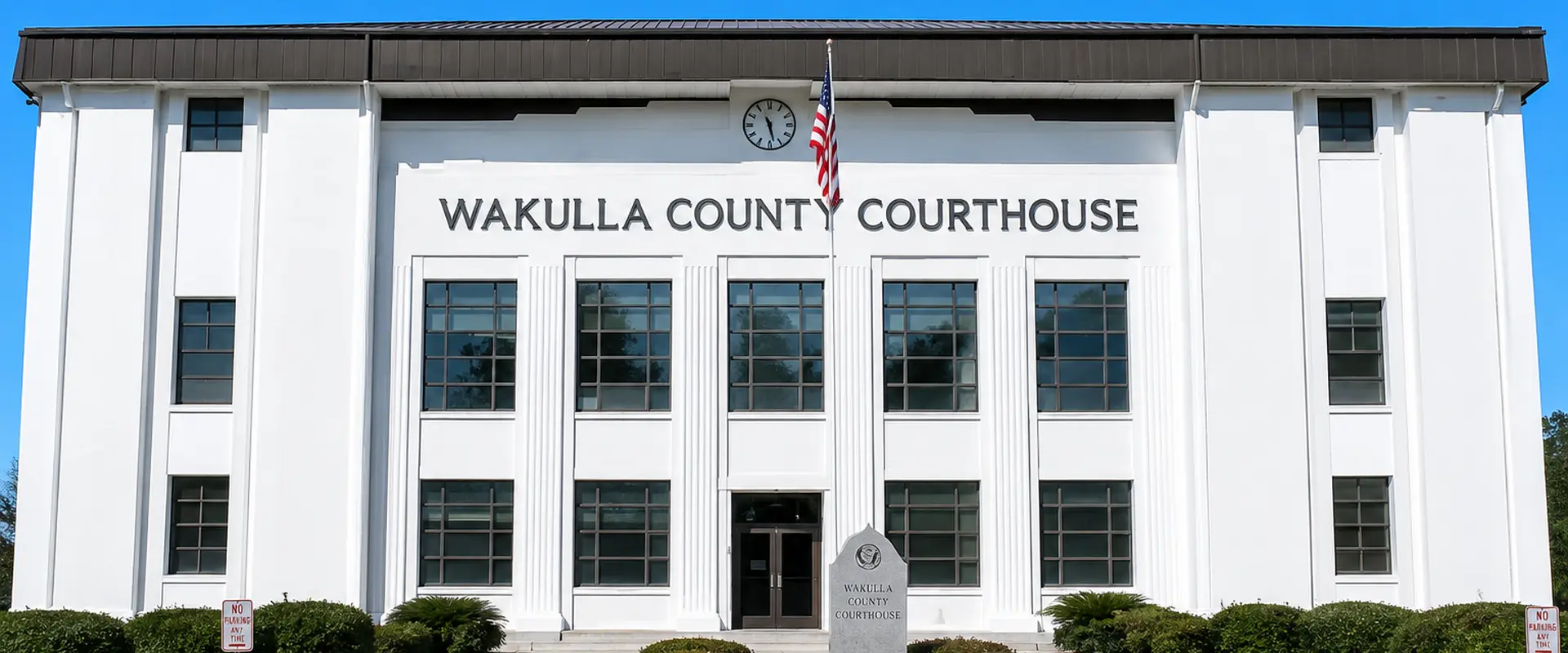
Wakulla County Courthouse
Florida's Second Judicial Circuit and the Wakulla County Court are housed here, where felony and misdemeanor prosecutions, civil and small claims disputes, family and domestic relations matters, probate and guardianship cases, juvenile proceedings, traffic citations, evictions, and foreclosure actions are filed, docketed, and adjudicated under one roof.
Crawfordville
Address: 3056 Crawfordville Highway, Crawfordville, FL 32327
Clerk of Court & Comptroller: (850) 926-0300
Courts Department: (850) 926-0300
Website: wakullaclerk.org
Division-Specific Contacts at the Courthouse.
Circuit Civil / Foreclosures / Probate & Guardianship: (850) 926-0301
County Civil / Small Claims / Jury: (850) 926-0359
Felony Division: (850) 926-0327
Misdemeanor Division: (850) 926-0316
Appeals: (850) 926-0374
Official Records (Marriage Licenses, Passports, Tax Deeds): (850) 926-0326
Collections & Compliance (Court Payments): (850) 926-0350
Legal Help and Self-Help Resources
Wakulla County residents do not have an in-county legal aid office, so they rely on the nearest office, which is based in Tallahassee. Also, Wakulla residents draw on a small network of regional nonprofits, statewide self-help tools, and procedural support at the local Clerk's counter.
 Free Legal Assistance
The main legal aid provider serving Wakulla County is Legal Services of North Florida (LSNF), based in Tallahassee. This primary nonprofit legal aid organization offers services in family law, housing, public benefits, consumer disputes, employment, education, and health care. It also prioritizes cases involving minors, older people, abuse survivors, veterans, and people with disabilities. Wakulla County residents also have access to the Legal Aid Foundation of the Tallahassee Bar Association.
 Local Legal Support
Florida State University College of Law operates the Public Interest Law Center in Tallahassee, which runs live-client clinics covering elder law, children's advocacy, immigration, and human trafficking matters. The services are accessible to Wakulla County residents by contacting the Public Interest Law Center. Wakulla County residents also have access to the Refuge House Resource, which helps the residents access local legal support on protective injunctions, victim compensation help, and immigration support. They also operate a local outreach office that caters to domestic violence legal issues.
FAQs
Can I look up Wakulla traffic tickets and pay them online without registering for an account?
Yes. Wakulla traffic citation payments don't require a credentialed login for case-document viewing. One can pay through the Wakulla Clerk's online payment portal using a citation number, driver's license number, or case number. Credit and debit cards are accepted.
Are pre-1892 Wakulla court records available anywhere?
Mostly no. A fire destroyed the original Crawfordville courthouse in 1892, consuming nearly all the county's early records, according to the Florida Memory historical archive. The Wakulla County Historical Society at 24 High Drive holds some surviving fragments, and the Florida State Archives in Tallahassee preserves scattered judicial records that predate the fire.
If I live in Panacea or Sopchoppy, do I have to drive to Crawfordville to file my case?
Yes, for in-person filing. The Wakulla County Courthouse is the only physical filing location in the county, and there are no satellite Clerk offices in Panacea, Sopchoppy, St. Marks, or any other community. One can avoid the drive entirely by using the Florida Courts E-Filing Portal to submit civil, family, probate, and small claims filings electronically from anywhere with internet access.
Do Circuit Judges actually come to Wakulla, or are hearings held in Tallahassee?
Circuit Judges from the Second Judicial Circuit travel to Wakulla. Hearings for felony, family, probate, and major civil cases are held at the Crawfordville courthouse rather than requiring residents to drive to Tallahassee. The circuit's judicial assignment system rotates Circuit Judges through Wakulla on a divisional schedule, while the County Judge maintains permanent chambers at the Wakulla County Courthouse.
What happens if my case involves someone who lives in Leon or Franklin County?
Jurisdiction usually follows where the incident happened or where the defendant resides, not where one lives. Cases involving cross-county defendants often require some coordination between the Wakulla Clerk and the receiving county's clerk. For multi-county searches when unsure where a case was filed, aggregator tools like CourtCaseFinder pull public docket data across Florida counties into one interface.
Does Wakulla have a Veterans Court or Drug Court I can be referred to?
Wakulla doesn't run standalone problem-solving courts, but eligible defendants can be referred into the Second Judicial Circuit's specialty dockets, which operate out of Leon County and accept Wakulla referrals. The Second Judicial Circuit administers Drug Court, Veterans Court, and Mental Health Court programs across all six member counties.
Can I evict a tenant in Wakulla without hiring a lawyer?
Yes, self-representation is common in Wakulla evictions. The Wakulla County Court's civil division handles landlord-tenant cases, and the Clerk provides pre-printed eviction packets at the counter. File a three-day notice, then a complaint for tenant eviction, pay the filing fee, and arrange service through the Wakulla Sheriff. The Florida Courts forms library hosts approved residential eviction forms. Contested evictions involving counterclaims or commercial leases generally warrant hiring an attorney.
Does Wakulla County have an emergency hearing?
Yes, the county has emergency hearings, which, like most of the other cases, you can file through the county clerk's office during business hours. These cases are handled through the county's 2nd Circuit on-call Judge, who is on duty at the time of the emergency case filing.
Other Counties in Florida
- Alachua
- Baker
- Bay
- Bradford
- Brevard
- Broward
- Calhoun
- Charlotte
- Citrus
- Clay
- Collier
- Columbia
- De Soto
- Dixie
- Duval
- Escambia
- Flagler
- Franklin
- Gadsden
- Gilchrist
- Glades
- Gulf
- Hamilton
- Hardee
- Hendry
- Hernando
- Highlands
- Hillsborough
- Holmes
- Indian River
- Jackson
- Jefferson
- Lafayette
- Lake
- Lee
- Leon
- Levy
- Liberty
- Madison
- Manatee
- Marion
- Martin
- Miami-Dade
- Monroe
- Nassau
- Okaloosa
- Okeechobee
- Orange
- Osceola
- Palm Beach
- Pasco
- Pinellas
- Polk
- Putnam
- Saint Johns
- Saint Lucie
- Santa Rosa
- Sarasota
- Seminole
- Sumter
- Suwannee
- Taylor
- Union
- Volusia
- Walton
- Washington
Table of Contents